
Navigating Market Volatility Series December 2024
After two years of strong returns from investment markets, it is easy to forget that periods of volatility — such as share market pull-backs or corrections — are a common and normal part of investing. What better time, then, to unpack some key concepts about navigating market volatility to better prepare you for what may lie ahead.
Concept #3: Time in the market, not timing the market
During periods of market volatility, many investors react by shifting from growth assets, such as shares, to defensive assets like cash. After periods of strong returns from shares, some investors may also decide to move to cash to lock in gains. The temptation may be even stronger with interest rates at their highest levels in years. However, the safety of cash can be deceptive and may lead to missed opportunities for growth. Investors risk missing out on significant long-term gains that can enhance their wealth by avoiding growth assets. For those accumulating wealth for retirement, this means their savings are not working effectively, resulting in smaller retirement savings. For retirees, depending exclusively on cash may elevate the risk of exhausting their savings prematurely.
Over time, growth assets typically deliver higher returns than defensive assets. These higher returns are crucial for protecting against inflation and preserving the value of your capital and income. In contrast, cash returns rarely beat inflation by any meaningful margin. Investing in shares offers both capital growth and regular, growing income through dividends. Australian shares, in particular, are known for their generous dividends, often with franking credits. The chart below compares the performance of an initial $100,000 investment in cash and Australian shares 30 years ago. Despite many periods of short-term volatility, the long-term returns from shares significantly outperform cash, helping investors build and sustain wealth.
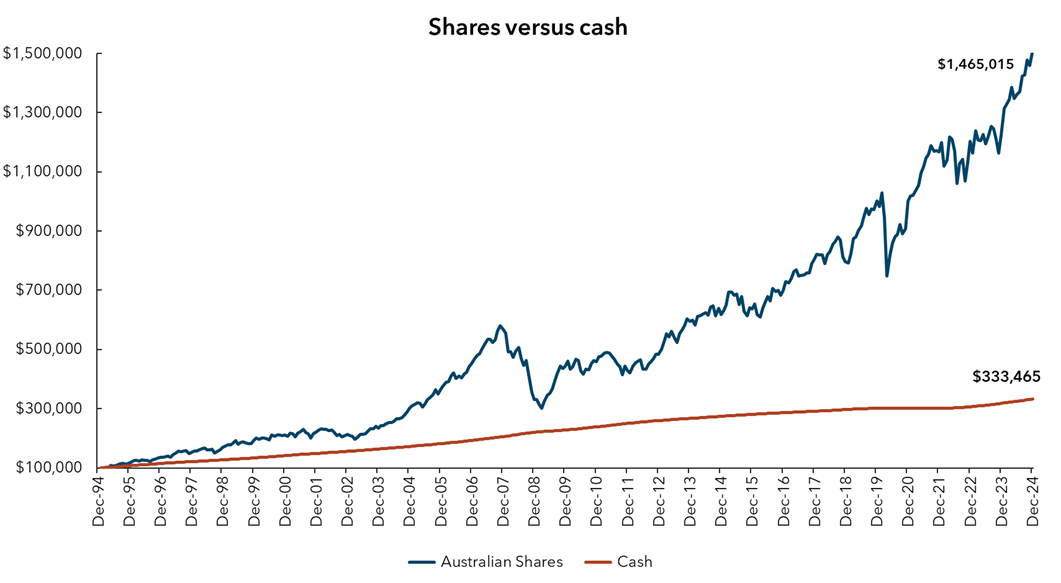
Morningstar/Evidentia. Annualised returns (reinvested) of $100,000 invested in the S&P/ASX All Ordinaries TR Index and RBA Bank Accepted Bills (90 days) 1995-2024.
Ironbark Advice is the sponsor of the Partners Portfolios. Ironbark Advice is comprised of the following wholly owned entities of Ironbark: Advice First Pty Ltd, Advisory Group Pty Ltd, ARTT Group Pty Ltd, Brisbane Financial Services Pty Ltd, Elevate Financial Solutions Pty Ltd, Emohruo Financial Services Pty Ltd, Invest Blue Armidale Pty Ltd, Invest Blue Brisbane Pty Ltd, Invest Blue Coffs Harbour Pty Ltd, Invest Blue Direct Pty Ltd, Invest Blue Gladstone Pty Ltd, Ogilvie Financial Services Pty Ltd, TDT (Tas) Pty Ltd, The Bravien Group Pty Ltd, Vintage Wealth Pty Ltd and Wainscott Financial Planning & Advice Pty Ltd, trading as Ironbark Advice are authorised representatives and credit representatives of Akumin Financial Planning Pty Limited, Australian Financial Services Licence and Australian Credit Licence No. 232706. Countrywide Advice Pty Ltd and GrowUp Financial Pty Ltd trading as Ironbark Advice are authorised representatives and credit representatives of Charter Financial Planning Limited, Australian Financial Services Licence and Australian Credit Licence No. 234665. GR & LC Thompson Pty Ltd trading as Ironbark Advice, is an authorised representative and credit representative of Hillross Financial Services Limited, Australian Financial Services Licence and Australian Credit Licence No. 232705. LFC Advice Pty Ltd (ABN 19 647 509 466) trading as Ironbark Advice, is a Corporate Authorised Representative of LFC Group Pty Ltd (ABN 35 644 576 965), AFSL 526600.