
Navigating Market Volatility Series
After a strong period of performance for investment markets, it is easy to forget that periods of market volatility — such as share market pull-backs or corrections — are actually a very common and normal part of investing. What better time, then, to unpack some key concepts about navigating market volatility to better prepare you for what may lie ahead.
Concept #1: Turn down the noise
Noise is anything that can potentially distract us from doing what we should be doing. In investment markets, there is an endless flow of news and data that attempts to explain and predict market movements. Much of this news flow comes from mainstream media, which tends to focus on the negatives because, as the old saying goes, “bad news sells!”.
Turning down the noise, particularly during periods of heightened market volatility, is critical. It helps us avoid being swept up in emotion, and instead, concentrate on making better investment decisions based on facts. Because so much of the noise we are confronted with is short-term, the best way for investors to turn it down is to focus on their long-term investment strategy. Will the specific issues we face today, like inflation, high interest rates, and geopolitical tensions, be as relevant in five or ten years? Probably not.
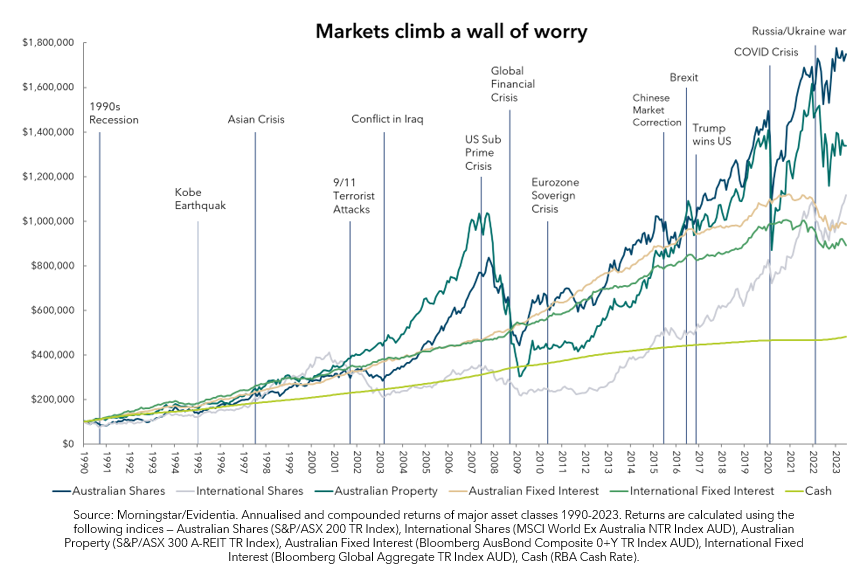
Looking back at history can also help investors put short-term noise about market events into perspective. The following chart shows the performance of the major asset classes since 1990. Despite numerous macroeconomic, geopolitical, and health events occupying investors’ attention at various times over this period, the market has continued to climb the so-called “wall of worry” and pushed higher.
Ironbark Advice is the sponsor of the Partners Portfolios. Ironbark Advice is comprised of the following wholly owned entities of Ironbark: Advice First Pty Ltd, Advisory Group Pty Ltd, ARTT Group Pty Ltd, Brisbane Financial Services Pty Ltd, Elevate Financial Solutions Pty Ltd, Emohruo Financial Services Pty Ltd, Invest Blue Armidale Pty Ltd, Invest Blue Brisbane Pty Ltd, Invest Blue Coffs Harbour Pty Ltd, Invest Blue Direct Pty Ltd, Invest Blue Gladstone Pty Ltd, Ogilvie Financial Services Pty Ltd, TDT (Tas) Pty Ltd, The Bravien Group Pty Ltd, Vintage Wealth Pty Ltd and Wainscott Financial Planning & Advice Pty Ltd, trading as Ironbark Advice are authorised representatives and credit representatives of Akumin Financial Planning Pty Limited, Australian Financial Services Licence and Australian Credit Licence No. 232706. Countrywide Advice Pty Ltd and GrowUp Financial Pty Ltd trading as Ironbark Advice are authorised representatives and credit representatives of Charter Financial Planning Limited, Australian Financial Services Licence and Australian Credit Licence No. 234665. GR & LC Thompson Pty Ltd trading as Ironbark Advice, is an authorised representative and credit representative of Hillross Financial Services Limited, Australian Financial Services Licence and Australian Credit Licence No. 232705. LFC Advice Pty Ltd (ABN 19 647 509 466) trading as Ironbark Advice, is a Corporate Authorised Representative of LFC Group Pty Ltd (ABN 35 644 576 965), AFSL 526600.