
Navigating Market Volatility Series December 2025
Markets continue to experience periods of uncertainty, with fluctuations that can test investor confidence and raise questions about when to invest. This environment provides a timely opportunity to revisit another key principle for navigating market ups and downs: the importance of maintaining discipline through volatility, staying focused on long-term objectives, and continuing to put capital to work in a considered and consistent way.
Concept #8: Dollar-cost averaging — investing through volatility
For many investors, investing is an ongoing process rather than a one-off decision. Regular contributions to superannuation or monthly investment plans mean money is invested consistently over time, regardless of short-term market movements — an approach known as dollar-cost averaging. While market volatility can feel uncomfortable, it can work in favour of investors who are still accumulating assets. When markets fall, regular contributions buy more units at lower prices, and when markets rise, fewer units are purchased at higher prices. Over time, this can result in a lower average purchase price and a greater number of units once markets recover.
Dollar-cost averaging also delivers a powerful behavioural benefit. By spreading investment decisions over time, it reduces the pressure to “get the timing right” and lowers the regret associated with investing just before a market downturn. Rather than trying to predict short-term market movements, investors can focus on consistency and discipline. In this way, regular investing helps turn market volatility from a source of anxiety into a long-term advantage.
The table below illustrates this concept by comparing two investors who each invest $6,000 over six months using different approaches. Investor A invests $1,000 each month as prices fluctuate, while Investor B invests the full amount upfront. As shown, Investor A accumulates 628 units (average unit price of $9.55) compared with Investor B’s 600 units (average unit price of $10.00), despite both investing the same total amount. This example highlights how dollar-cost averaging can help smooth the impact of market volatility, reduce the risk of poor timing, and potentially enhance long-term outcomes.
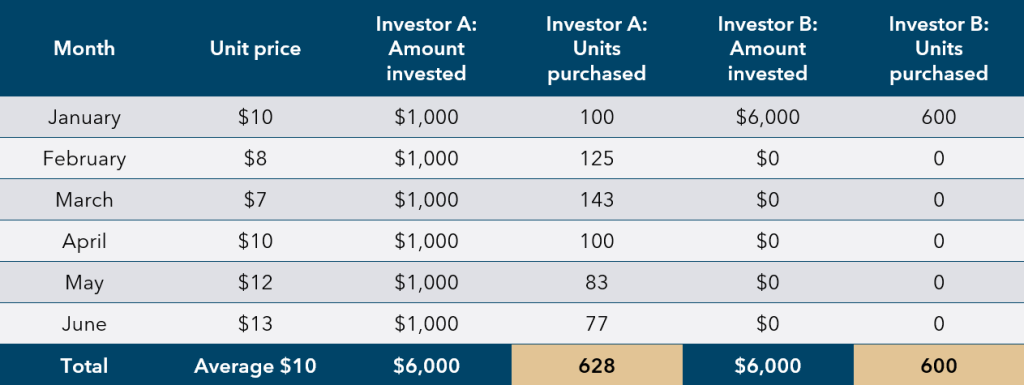
It is important to note that dollar-cost averaging is not always the most effective strategy from a purely return-focused perspective. Vanguard research shows that in generally rising markets, investing a lump sum upfront has historically delivered better outcomes about two-thirds of the time because it is invested sooner. However, dollar-cost averaging can be valuable during volatile markets, after extended rallies, or for more risk-averse investors. In these situations, it can help manage behavioural risks and support investment discipline, particularly compared with remaining in cash.
Ironbark Advice is the sponsor of the Partners Portfolios. Ironbark Advice is comprised of the following wholly owned entities of Ironbark: Advice First Pty Ltd, Advisory Group Pty Ltd, ARTT Group Pty Ltd, Brisbane Financial Services Pty Ltd, Elevate Financial Solutions Pty Ltd, Emohruo Financial Services Pty Ltd, Invest Blue Armidale Pty Ltd, Invest Blue Brisbane Pty Ltd, Invest Blue Coffs Harbour Pty Ltd, Invest Blue Direct Pty Ltd, Invest Blue Gladstone Pty Ltd, Ogilvie Financial Services Pty Ltd, TDT (Tas) Pty Ltd, The Bravien Group Pty Ltd, Vintage Wealth Pty Ltd and Wainscott Financial Planning & Advice Pty Ltd, trading as Ironbark Advice are authorised representatives and credit representatives of Akumin Financial Planning Pty Limited, Australian Financial Services Licence and Australian Credit Licence No. 232706. Countrywide Advice Pty Ltd and GrowUp Financial Pty Ltd trading as Ironbark Advice are authorised representatives and credit representatives of Charter Financial Planning Limited, Australian Financial Services Licence and Australian Credit Licence No. 234665. GR & LC Thompson Pty Ltd trading as Ironbark Advice, is an authorised representative and credit representative of Hillross Financial Services Limited, Australian Financial Services Licence and Australian Credit Licence No. 232705. LFC Advice Pty Ltd (ABN 19 647 509 466) trading as Ironbark Advice, is a Corporate Authorised Representative of LFC Group Pty Ltd (ABN 35 644 576 965), AFSL 526600.