
Navigating Market Volatility Series September 2024
After another strong quarter for investment markets, it is easy to forget that periods of volatility — such as share market pull-backs or corrections — are a common and normal part of investing. What better time, then, to unpack some key concepts about navigating market volatility to better prepare you for what may lie ahead.
Concept #3: Time in the market, not timing the market
Markets tend to rise over the long term but often experience short-term volatility, with declines typically occurring faster than gains. This volatility can challenge even seasoned investors. Some attempt to navigate this by timing their entry and exit, trying to avoid downturns and capture upswings — known as ‘market timing.’ However, predicting short-term market movements is nearly impossible, making this approach highly risky.
The biggest risk of market timing is being uninvested when markets unexpectedly rebound. Moving out of growth assets like shares into defensive ones like cash during these moments can result in missing the market’s best days, significantly impacting long-term returns. The chart below illustrates the annualised returns of Australian shares and a hypothetical $10,000 investment over the past 20 years, comparing the outcomes of remaining fully invested versus missing some of the best returns days.
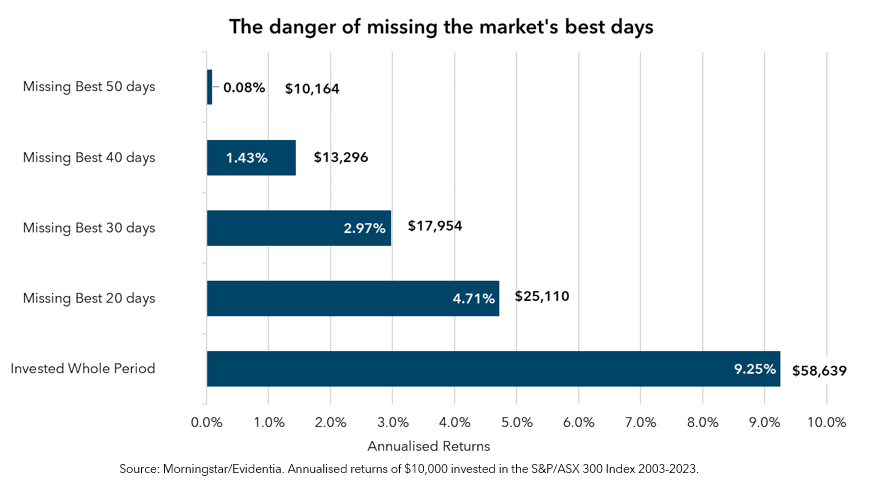
If an investor had remained invested in Australian shares over the 20-year period, their $10,000 would have grown at an average annual rate of 9.25%, reaching $58,639. However, if they had tried to time the market and missed just the 20 best days, their investment would have only grown to $25,110 — less than half. Missing the best 50 days would have resulted in their initial $10,000 investment declining in value after taking account of inflation. The key to successful long-term investing is maintaining the discipline and patience to stay invested. Time in the market, not timing the market, builds wealth.
Ironbark Advice is the sponsor of the Partners Portfolios. Ironbark Advice is comprised of the following wholly owned entities of Ironbark: Advice First Pty Ltd, Advisory Group Pty Ltd, ARTT Group Pty Ltd, Brisbane Financial Services Pty Ltd, Elevate Financial Solutions Pty Ltd, Emohruo Financial Services Pty Ltd, Invest Blue Armidale Pty Ltd, Invest Blue Brisbane Pty Ltd, Invest Blue Coffs Harbour Pty Ltd, Invest Blue Direct Pty Ltd, Invest Blue Gladstone Pty Ltd, Ogilvie Financial Services Pty Ltd, TDT (Tas) Pty Ltd, The Bravien Group Pty Ltd, Vintage Wealth Pty Ltd and Wainscott Financial Planning & Advice Pty Ltd, trading as Ironbark Advice are authorised representatives and credit representatives of Akumin Financial Planning Pty Limited, Australian Financial Services Licence and Australian Credit Licence No. 232706. Countrywide Advice Pty Ltd and GrowUp Financial Pty Ltd trading as Ironbark Advice are authorised representatives and credit representatives of Charter Financial Planning Limited, Australian Financial Services Licence and Australian Credit Licence No. 234665. GR & LC Thompson Pty Ltd trading as Ironbark Advice, is an authorised representative and credit representative of Hillross Financial Services Limited, Australian Financial Services Licence and Australian Credit Licence No. 232705. LFC Advice Pty Ltd (ABN 19 647 509 466) trading as Ironbark Advice, is a Corporate Authorised Representative of LFC Group Pty Ltd (ABN 35 644 576 965), AFSL 526600.