
Navigating Market Volatility Series September 2025
After a strong run in recent months, markets are once again testing new highs, a reminder that momentum can sometimes endure longer than many expect, even amid lingering uncertainties. Elevated valuations and shifting expectations may prompt some investors to question whether the rally can continue. Yet this also presents a timely opportunity to revisit some key principles for managing through market ups and downs and to reinforce the importance of staying invested, diversified, and focused on your long-term strategy.
Concept #7: Diversification – don’t put all your eggs in one basket
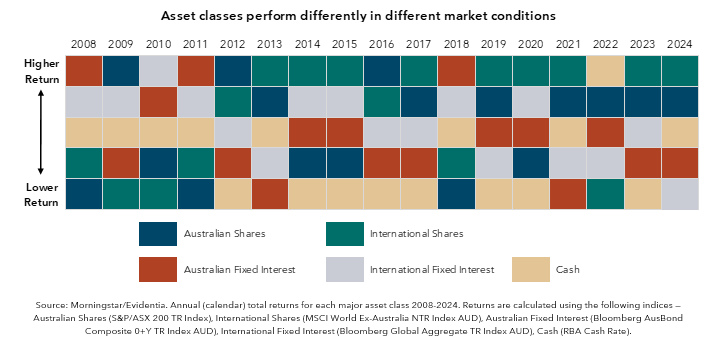
While media headlines often spotlight major indices such as the S&P 500 or S&P/ASX 200, most investors hold a much broader mix of assets within their portfolios. Diversification remains one of the most effective ways to manage risk and achieve more consistent returns through changing market conditions. By spreading investments across and within asset classes — including shares, bonds (fixed interest), and cash — investors can benefit from the fact that these assets tend to perform differently at various points in the market cycle. This process, known as asset allocation, is tailored to each investor’s circumstances, goals, and tolerance for risk.
The table below highlights annual returns across major asset classes commonly held in Australian portfolios since the Global Financial Crisis. What stands out is how unpredictable relative performance can be from year to year. Rather than chasing last year’s top performers, a well-diversified portfolio helps smooth out the ups and downs, positioning investors to achieve steadier results over the long term.
Ironbark Advice is the sponsor of the Partners Portfolios. Ironbark Advice is comprised of the following wholly owned entities of Ironbark: Advice First Pty Ltd, Advisory Group Pty Ltd, ARTT Group Pty Ltd, Brisbane Financial Services Pty Ltd, Elevate Financial Solutions Pty Ltd, Emohruo Financial Services Pty Ltd, Invest Blue Armidale Pty Ltd, Invest Blue Brisbane Pty Ltd, Invest Blue Coffs Harbour Pty Ltd, Invest Blue Direct Pty Ltd, Invest Blue Gladstone Pty Ltd, Ogilvie Financial Services Pty Ltd, TDT (Tas) Pty Ltd, The Bravien Group Pty Ltd, Vintage Wealth Pty Ltd and Wainscott Financial Planning & Advice Pty Ltd, trading as Ironbark Advice are authorised representatives and credit representatives of Akumin Financial Planning Pty Limited, Australian Financial Services Licence and Australian Credit Licence No. 232706. Countrywide Advice Pty Ltd and GrowUp Financial Pty Ltd trading as Ironbark Advice are authorised representatives and credit representatives of Charter Financial Planning Limited, Australian Financial Services Licence and Australian Credit Licence No. 234665. GR & LC Thompson Pty Ltd trading as Ironbark Advice, is an authorised representative and credit representative of Hillross Financial Services Limited, Australian Financial Services Licence and Australian Credit Licence No. 232705. LFC Advice Pty Ltd (ABN 19 647 509 466) trading as Ironbark Advice, is a Corporate Authorised Representative of LFC Group Pty Ltd (ABN 35 644 576 965), AFSL 526600.